

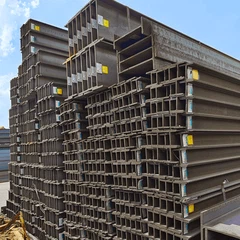


can be composed of various stress components according to different needs of the structure, and can also be used as a connector between components. Widely used in various building structures and engineering structures, such as beams, bridges, transmission towers, lifting and transportation machinery, ships, industrial furnaces, reaction towers, container racks, cable trench supports, power piping, busbar support installation, and warehouses shelves etc.
Types of angle steel: mainly divided into two types: equilateral angle steel and unequal side angle steel, among which unequal side angle steel can be divided into two types: unequal sides and equal thickness and unequal sides and unequal thickness.
Hot rolled and cold formed standard angle steels, compliant with ASTM and GB standards, featuring 100X100 specifications and available in L and I shapes, cover a comprehensive range of high-performance grades including S235jr, S275jr, A572 Gr50, Gr60, A36, and SS400. These versatile structural components are engineered to meet the rigorous demands of global construction, infrastructure, and industrial sectors, integrating standardized dimensional precision, diverse material properties, and dual forming processes. Their adaptability to various design requirements and compatibility with international standards make them a cornerstone in load-bearing, framing, and reinforcing applications worldwide.
Dual forming processes-hot rolling and cold forming-define the performance characteristics of these angle steels. Hot rolled angle steels are manufactured by heating steel billets to high temperatures and rolling them into the desired L or I shape, which refines the grain structure, enhancing toughness, ductility, and weldability. This process is ideal for heavy-duty applications requiring superior load-bearing capacity. Cold formed angle steels, by contrast, are shaped at room temperature through precise rolling, resulting in tighter dimensional tolerances, smoother surface finishes, and improved strength-to-weight ratios, making them suitable for applications demanding high precision and aesthetic appeal. Both processes adhere to strict ASTM and GB standards, ensuring consistent quality across all batches.
The diverse range of material grades caters to varied performance requirements. S235jr and S275jr (EN standards) offer reliable mechanical properties, with minimum yield strengths of 235 MPa and 275 MPa respectively, suitable for general structural applications. A36 (ASTM standard), a globally recognized grade with 250 MPa minimum yield strength, balances ductility and weldability for universal use. A572 Gr50 and Gr60 (ASTM standard) are high-strength grades, boasting minimum yield strengths of 345 MPa and 414 MPa, ideal for heavy-duty infrastructure and high-rise construction. SS400 (JIS standard), with 245 MPa minimum yield strength, provides cost-effective reliability for medium-duty applications. All grades are optimized for compatibility with the 100X100 specification, ensuring uniform load distribution and structural stability.
The 100X100 standard specification and L/I shape designs are engineered for versatility. The 100mm equal leg (for L-shape) and 100mm section (for I-shape) ensure balanced force transmission, enabling the angle steels to effectively resist bending, shear, and torsional stresses. L-shaped angle steels are widely used for bracing, framing, and reinforcement, while I-shaped (I-beam) angle steels excel in load-bearing applications such as beams and columns. Compliance with both ASTM and GB standards ensures global applicability, allowing these products to seamlessly integrate into projects across different regions. Strict quality control measures, including material composition testing, mechanical property verification, and dimensional inspection, are implemented throughout production to guarantee product reliability.
These standard angle steels find extensive applications across industries. In construction, they are used in high-rise building frameworks, roof trusses, wall bracing, and concrete reinforcement. Infrastructure projects, such as bridges, highways, railways, and water conservancy facilities, rely on their high strength and durability. In industrial settings, they serve as key components in machinery frames, equipment supports, heavy-duty storage racking, and workshop platforms. The combination of dual forming processes, diverse material grades, and standardized shapes/specifications makes them suitable for custom fabrication, adapting to unique project requirements while maintaining structural integrity and performance.
In conclusion, the hot rolled and cold formed ASTM/GB standard angle steels (100X100, L/I shape) with grades S235jr, S275jr, A572 Gr50/Gr60, A36, and SS400 represent a comprehensive and reliable structural solution. Their dual forming processes, diverse material properties, and compliance with international standards cater to a wide spectrum of light, medium, and heavy-duty applications. With standardized dimensional precision, excellent mechanical performance, and global applicability, these angle steels provide cost-effective and versatile options for engineers, contractors, and manufacturers, playing a pivotal role in enhancing the safety, efficiency, and durability of global construction and industrial projects.
| 2mm-10mm | |
| 50-300 mm | |
| Q235 Q345 ST35 ST52 S355 E355 A36 | |
| Stocks within 3 days, customized around 7 working days. | |
| ±0.1mm |


